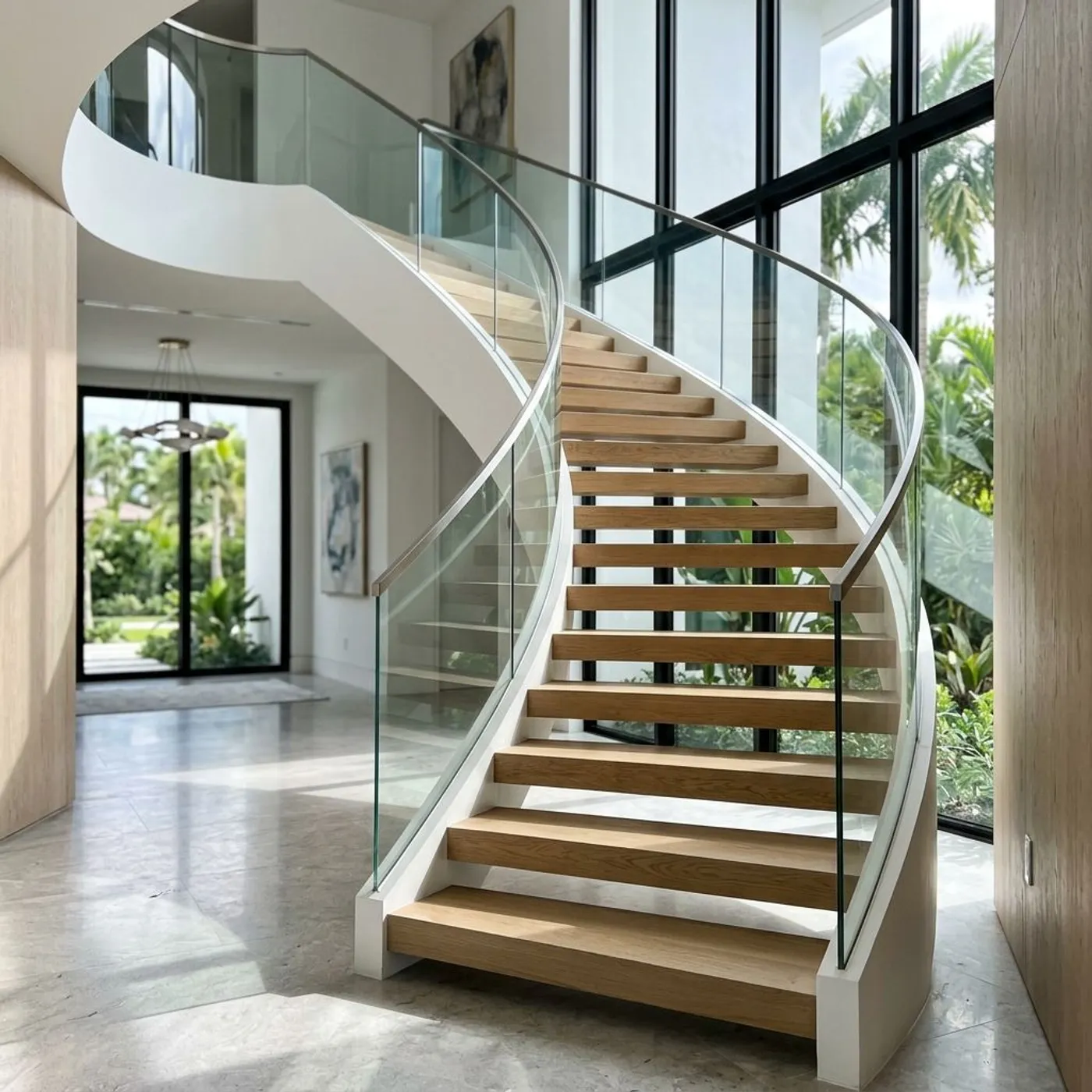
Curved Cantilevered Staircase Design in Hempstead, NY
Custom curved geometry engineered from field measurements — built around your actual floor plan, not adjusted to fit a standard riser count.
At Hempstead Floating Stairs , curved cantilevered staircases start from a full field survey of the space — because no two Nassau County homes have identical foyer geometry, ceiling height, or floor-to-floor dimensions.
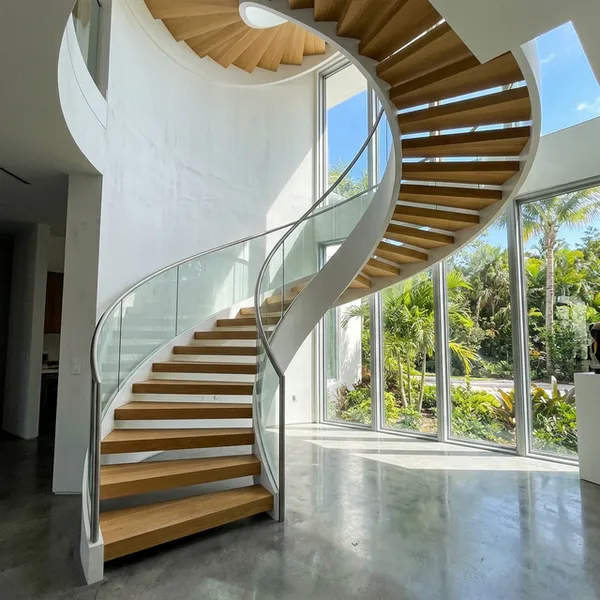
A curved cantilevered stair is one of the most structurally complex residential stair types. The horizontal offset between the top and bottom landings, combined with the curve radius, determines whether a single-spine steel stringer is structurally viable or whether a twin-stringer or central support column is required. That decision has to be made from actual measurements, not from a client's description of the space or a rough floor plan. We take full dimensional field measurements before any design work begins.
The stringer for a curved system is fabricated from plate steel bent to the designed radius — not approximated with a series of straight sections welded together. Straight-segment approximations look acceptable on paper but create abrupt transitions in curvature that are visible in the finished stair and concentrate stress at the segment joints. Our shop bends continuous plate to the engineered radius, which produces a smooth geometric curve and distributes load evenly along the stringer length.
Winder treads on curved stairs are wider on the outside radius than the inside. The New York State Building Code requires that the tread depth be measured at a point 12 inches from the narrow end, and that minimum tread depth be maintained at the walk line — the center of the stair path. We detail every tread geometry to comply with these requirements and verify compliance for each step in the run, not just the average.
Wall connection for curved systems is more complex than a straight stair because the anchor points span a curved arc. We map anchor locations to coincide with framing elements — studs, blocking, or structural headers — so each anchor sets into solid material, not into drywall or cavity space. In Nassau County homes where the curved stair runs against an exterior wall, we also verify there's no insulation cavity directly behind the anchor zone that could affect embedment depth.
Fabrication time for curved systems is typically 6 to 8 weeks from engineering approval. The geometry requires more shop time than straight stringers, and the continuous-bend process has a slower cycle than straight cuts. We build that lead time into the project schedule from day one.
Ready to get started?
We'll review your Nassau County project and provide a detailed proposal within 48 hours.
- ✓ Licensed & Insured in New York
- ✓ Nassau County Permit-Ready Documentation
- ✓ On-Time Completion Guarantee
- ✓ Site Assessment
How We Deliver Curved Cantilevered Staircase Design
Curved Cantilevered Staircase Design — FAQ
Can a curved floating stair fit in a Nassau County colonial foyer?
How are winder treads on curved stairs calculated for New York Building Code compliance?
What is the difference between a bent stringer and a straight-segment approximation?
How long does it take to design and build a curved floating stair in Nassau County?
Does a curved stair cost more than a straight floating stair?
Start Your Curved Staircase Project Today
Contact Hempstead Floating Stairs for a site assessment and detailed quote tailored to your Nassau County property.