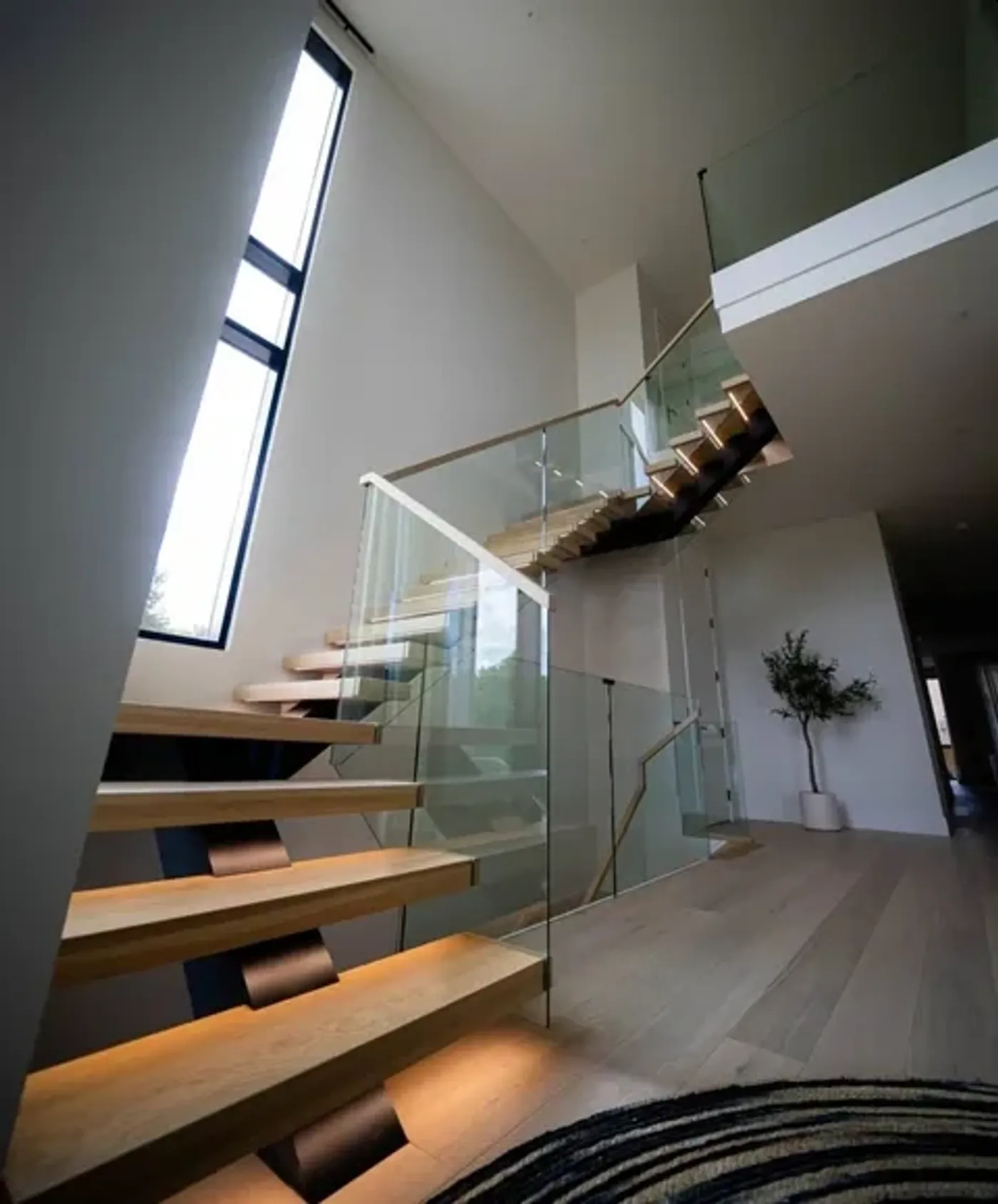
Custom Glass Balustrade Rail Systems in Hempstead, NY
Frameless glass panels with 304 or 316-grade standoffs — sized to New York Building Code guard height and hardware grade selected for your coastal proximity.
At Hempstead Floating Stairs , glass balustrade rail systems are designed and specified with New York Building Code compliance and Long Island's coastal climate as fixed requirements — not variables to optimize around cost.
The New York State Building Code requires a minimum 42-inch guard height at any open edge where the vertical drop exceeds 30 inches. For floating stairs, every open side of every tread is subject to this requirement. The 42-inch dimension is measured vertically from the stair nosing — not from the tread surface mid-span. This distinction matters because a guard that's dimensioned correctly from the tread surface will be undersized when measured from the nosing, particularly on steep stair runs. Every panel and post in our rail systems is positioned to the correct reference point.
The top rail of a glass guard must also resist a 200-pound concentrated load applied in any direction at any point along its length, per NYBC Section 1015. For frameless glass systems that rely on the glass panel itself as the guard — with a cap rail mounted directly to the glass top edge — the panel thickness and the standoff spacing determine whether that load rating is achieved. We calculate panel thickness and standoff spacing from the structural demand, not from a catalog default. Panels that are too thin or spaced too wide can't meet the 200-pound top rail requirement even if they look identical to a code-compliant installation.
Hardware grade selection for Nassau County requires knowing where on Long Island the home sits. The chloride concentration in salt air drops significantly as you move inland from the ocean or the Great South Bay. For properties in Freeport, coastal Hempstead, or Merrick near the water, 316-grade stainless standoffs and base channel are the right specification. For inland Nassau County locations — Garden City, Hempstead village center, Valley Stream — 304-grade performs well in a conditioned interior environment. We make this determination during the site assessment, not by applying a blanket specification to every project.
Panel glass for guard applications is specified as fully tempered — not just heat-strengthened, and not laminated unless the application requires a fallout-retention property. Fully tempered glass breaks into small blunt fragments if it fails, unlike annealed glass that breaks into large sharp pieces. NYBC Section 2407 specifies the glazing type required for guards and balustrades, and tempered glass to ASTM C1048 is the code-compliant standard for this application.
Installation sequence matters for glass guard systems. Standoffs are set into the stair structure during installation and verified for plumb before the glass panels are mounted. A misaligned standoff can't be corrected after the glass panel is in place — it would require removing and remounting the panel. We check standoff alignment before any panel is hung.
Ready to get started?
We'll review your Nassau County project and provide a detailed proposal within 48 hours.
- ✓ Licensed & Insured in New York
- ✓ Nassau County Permit-Ready Documentation
- ✓ On-Time Completion Guarantee
- ✓ Site Assessment
How We Deliver Custom Glass Balustrade Rail Systems
Custom Glass Balustrade Rail Systems — FAQ
What guard height does New York Building Code require for floating stairs?
Should I use 304 or 316-grade stainless for glass rail hardware in Nassau County?
What glass type is required for stair guard panels in New York?
How is the 200-pound top rail load requirement met with a frameless glass guard?
Can I combine a glass balustrade with cable or rod rails?
Start Your Glass Balustrade Rail Project Today
Contact Hempstead Floating Stairs for a site assessment and detailed quote tailored to your Nassau County property.